Why JavaScript Doesn't Need Threads
A deep dive into JavaScript's non-blocking execution model — event loop, call stack, microtask queue, and why the single-thread design is a feature, not a limitation.
2024-05-20
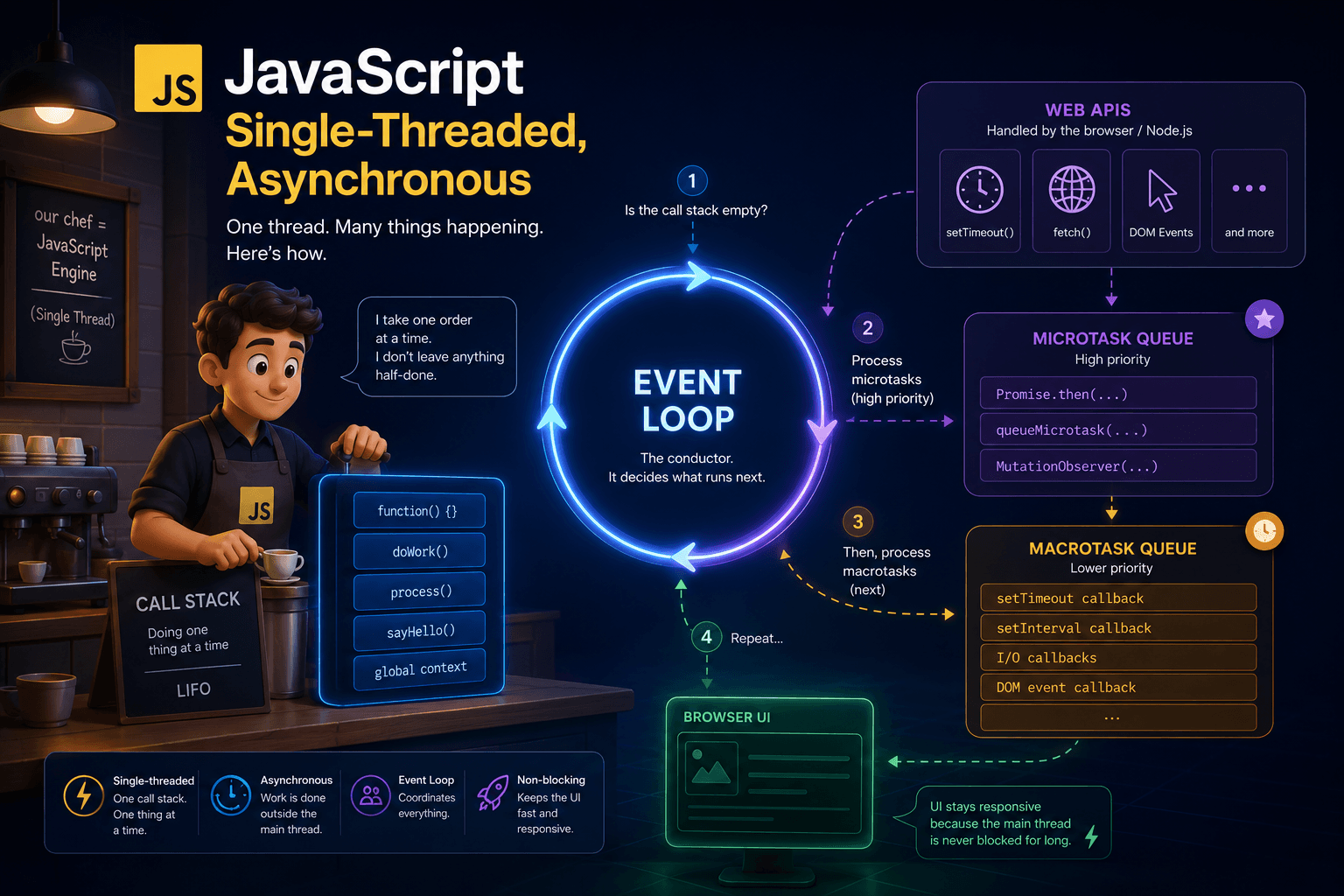
Understanding JavaScript's Single-Threaded Asynchronous Nature: The Magic Behind the Scenes
Why I'm Writing This
Hey there. Before we dive in, I want to share something with you. You know how in tech we're always chasing the next big thing? Microservices, serverless, Web 3.0. But recently, I've been thinking about how understanding the basics has been a game-changer for me. Sure, we have fancy tools like Web Workers and Node.js workers now, but knowing how JavaScript really works under the hood is what helps me solve tricky problems and make better decisions in my code.
It's kind of like building a house. You need solid foundations before adding all the cool stuff.
1. Introduction
Let me tell you about my journey with JavaScript. When I first started coding in JS after working with C++, I was honestly confused.
"Wait, what do you mean it's single-threaded? How does that even work?"
I kept thinking about all these apps I use daily. Like when I'm using Gmail, it's doing all these things at once: downloading new emails, updating the UI, handling my clicks, searching through emails. In C++, I'd just create multiple threads to handle all of that. But JavaScript is doing all of this with just one thread.
Once I understood how JavaScript handles this, it completely changed how I write code. JavaScript isn't just one thread doing one thing forever. It's a clever runtime model that makes everything flow.
2. The Single Thread vs Multiple Threads
Single-threaded languages, like JavaScript (in its traditional form) and PHP, can execute one task at a time in sequence. Multi-threaded languages like Java, Python, and C++ can execute multiple tasks simultaneously through parallel processing.
Multi-threading gives strong concurrency, but it also introduces complexity like race conditions and deadlocks.
Real-life analogy
Imagine you're a chef in a kitchen:
- In C++, it's like having multiple chefs (threads) working at the same time.
- In JavaScript, you're one chef, but with a brilliant system of assistants, timers, and organized workflow.
That raises the key question:
If JavaScript is single-threaded, how does it still handle complex, real-world workloads so well?
3. Memory Management: Stack and Heap
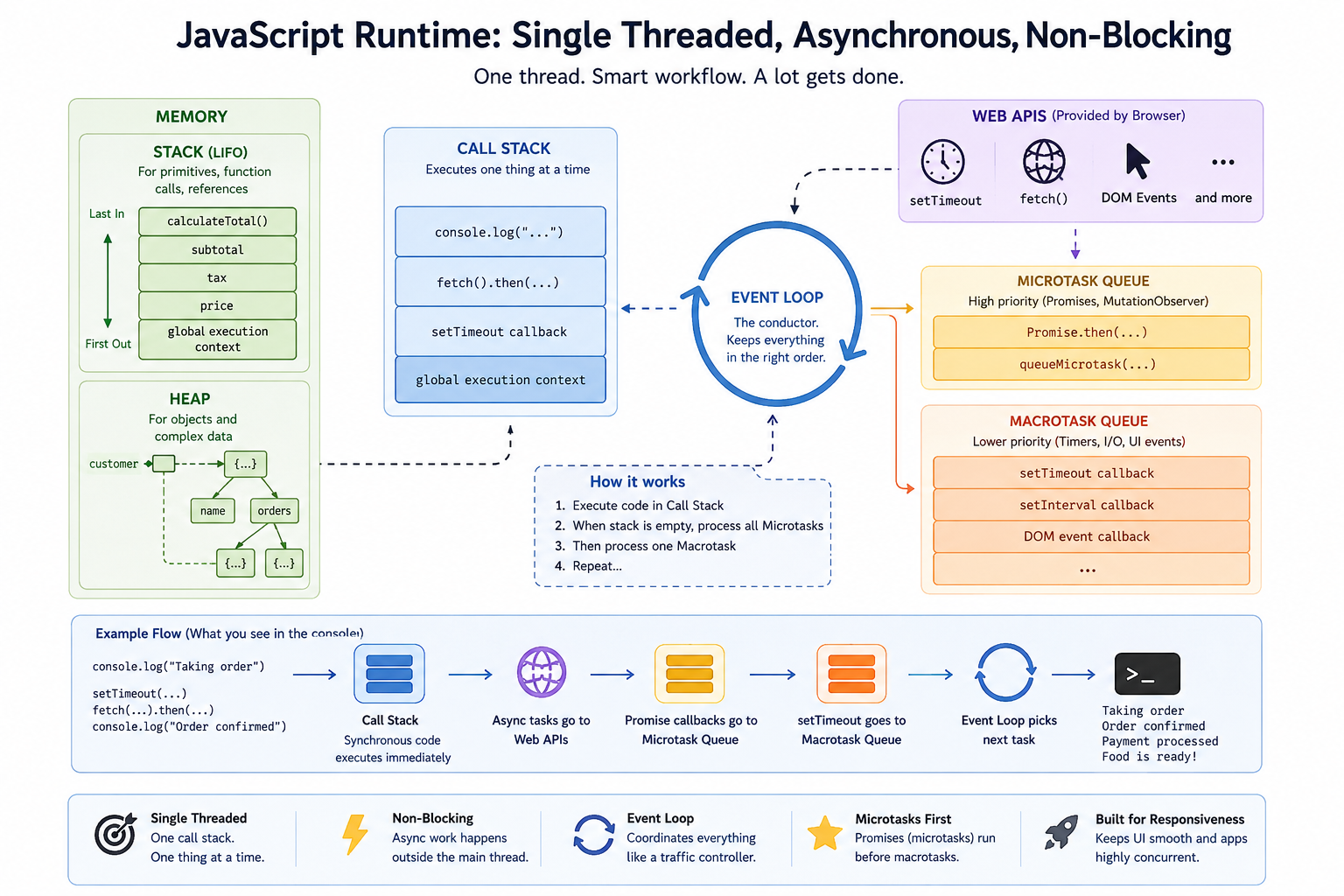
The Stack
The stack in JavaScript is like your organized workspace. It's where you keep:
- Function calls
- Primitive values
- Reference pointers
function calculateTotal(price, tax) {
  const subtotal = price + price * tax;
  return subtotal;
}

const total = calculateTotal(100, 0.2);
In this example, price, tax, and subtotal are stack values, and function calls are processed in LIFO order.
The Heap
The heap is like a pantry. It's larger, flexible storage for complex objects:
const customer = {
  name: "John",
  orders: [
    { id: 1, items: ["book", "pen"] },
    { id: 2, items: ["notebook"] },
  ],
};
This object is stored in the heap, while customer on the stack holds a reference.
4. Core Runtime Components
Before the event loop clicks, we need to know the key parts:
- Call Stack: Tracks function calls.
- Web APIs: Browser-provided async capabilities (
setTimeout,fetch, DOM events). - Task Queue (Callback Queue): Holds ready callbacks for macrotasks.
- Microtask Queue: Higher-priority queue for promises and mutation observers.
5. Sync vs Async (Coffee Shop Story)
In a sync world, you order coffee and stand there doing nothing until it's ready.
In an async world, you order coffee, get a buzzer, and continue with other tasks. When your coffee is ready, you get notified.
That buzzer is like a Promise.
This is JavaScript's superpower: it keeps the main thread responsive while async work is handled externally and resumed later.
6. The Event Loop: JavaScript's Secret Sauce
The event loop constantly checks:
- Is the stack empty?
- Are there pending microtasks?
- Are there pending macrotasks?
If the stack is free, it runs queued work in the correct priority order.
Simple example
function main() {
  console.log("Start");
  console.log("End");
}
This is synchronous. The event loop has almost nothing to coordinate here.
Async example
console.log("Taking order");

setTimeout(() => {
  console.log("Food is ready!");
}, 2000);

fetch("/api/payment-processing").then(() => {
  console.log("Payment processed");
});

console.log("Order confirmed");
Typical output order:
Taking order
Order confirmed
Payment processed
Food is ready!
The exact ordering of async completions can vary by timing, but microtasks (Promise.then) are processed before macrotasks (setTimeout) once the stack is clear.
What to take away from this
- JavaScript is single-threaded, but non-blocking by design.
- Async work is delegated to runtime/browser APIs.
- The event loop coordinates execution order.
- Microtasks have priority over macrotasks.
- Stack and heap separation keeps memory behavior predictable.
Conclusion
JavaScript's single-threaded nature is not a weakness. Combined with the event loop and non-blocking async model, it's exactly what makes JavaScript excellent for responsive UIs and high-concurrency web systems.
The next time someone says "JavaScript is single-threaded" as criticism, you can explain why this model is precisely what makes modern web apps fast and resilient.